
NOVEMBER 3, 2026 GENERAL ELECTION
In-Person Absentee Voting Hours:
Oct 20th - Oct 22nd (Tues - Thurs) 7:00 a.m. -4:00 p.m.
Oct 23rd (Fri) 7:00 a.m. – noon
Oct 26th & 27th Oct 29th & 30th (Mon, Tues, Thurs & Fri) 7:00 a.m.- 4:00 p.m.
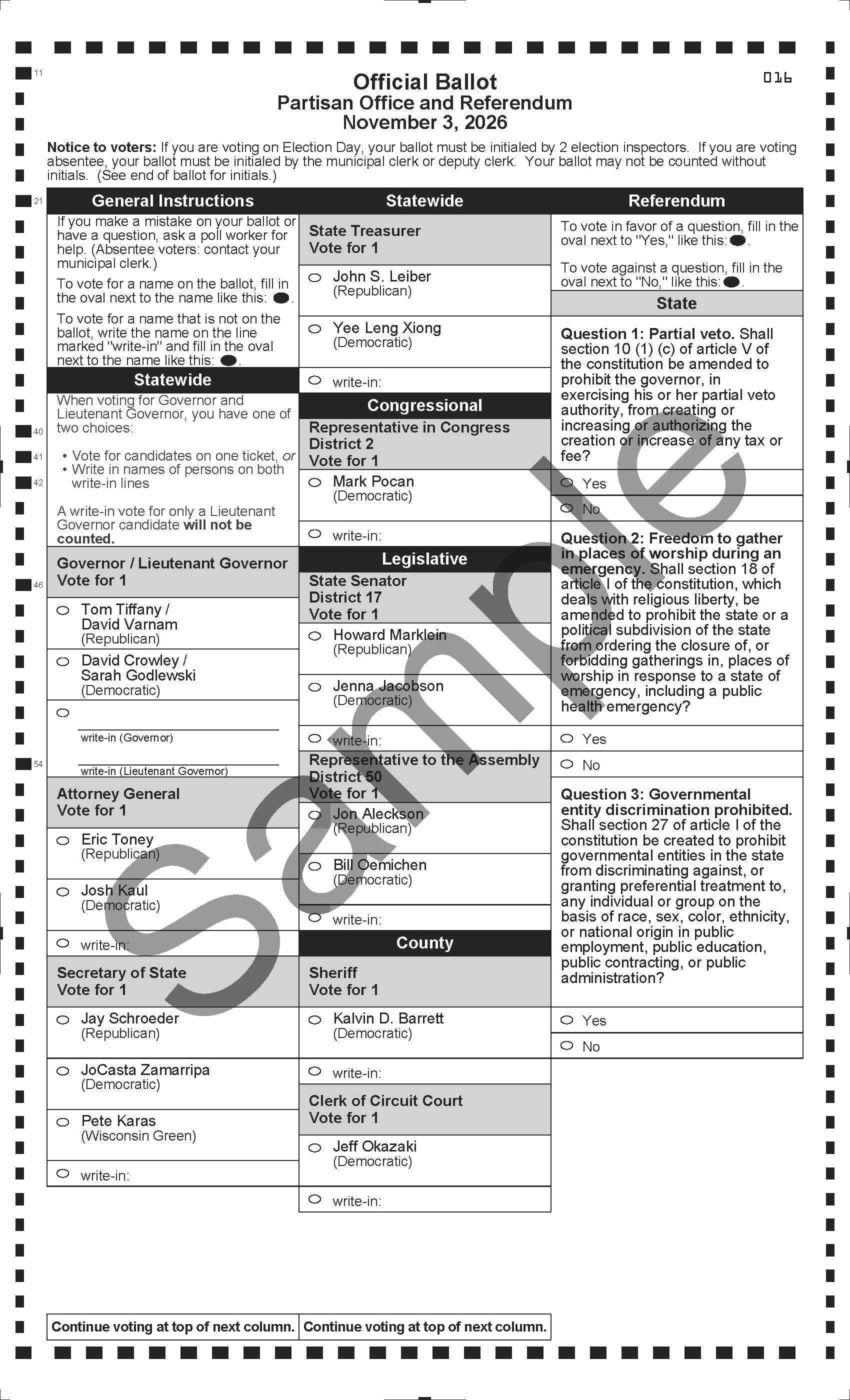
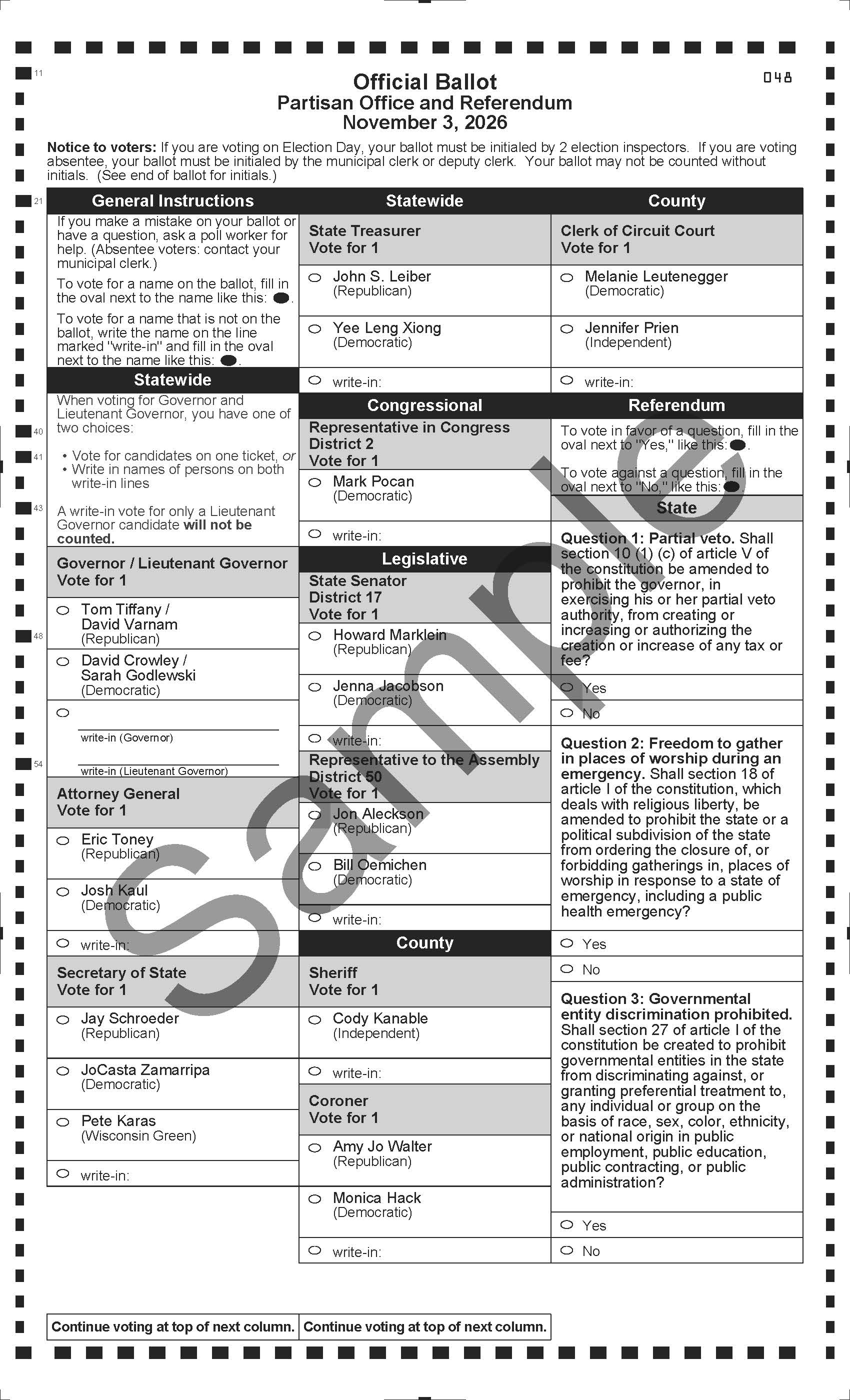
DANE COUNTY SAMPLE BALLOT GREEN COUNTY SAMPLE BALLOT
VOTING BY ABSENTEE BALLOT
VILLAGE OF OREGON < TOWN OF OREGON < TOWN OF RUTLAND < VILLAGE OF BROOKLYN
Any qualified elector who is unable or unwilling to appear at the polling place on Election Day may submit a request to vote an absentee ballot to their municipal clerk. A qualified elector is any U.S. citizen who:
- will be 18 years of age or older on Election Day and
- has resided in the ward or municipality where they wish to vote for at least 28 consecutive days before the election.
The elector must also be registered to vote to receive an absentee ballot. Proof of identification must be provided before an absentee ballot may be issued*.
Making an application to receive an absentee ballot by mail.
Contact your municipal clerk and request that an application for an absentee ballot be sent to you for the primary or election or both. You may make a written application to your municipal clerk for an absentee ballot in person, by mail, by fax, by email or at MyVote.wi.gov. Your written request must include: 1) your voting address within the municipality where you wish to vote; 2) the address where the absentee ballot should be sent, if different from the address above; 3) Your signature; 4) A copy of your photo identification*
The deadline for making application to receive an absentee ballot by mail is:
5:00 p.m. on the fifth day before the election, Thursday, October 29th, 2026 **
*Voters who are indefinitely confined due to age, illness, infirmity, or disability may not be required to provide photo ID. If this applies to you, contact the municipal clerk regarding deadlines for requesting and submitting an absentee ballot.
**Special absentee voting application provisions apply to electors who are indefinitely confined, in the military, hospitalized, or serving as a sequestered juror. If this applies to you, contact the municipal clerk regarding deadlines for requesting and submitting an absentee ballot.
Voting an absentee ballot in person
You may also request and vote an absentee ballot in the clerk's office or other specified location during the days and hours specified for casting an absentee ballot in person. The first and last day to vote an absentee ballot in your municipality is listed below. No in-person absentee voting may occur on the day before an election. The municipal clerk will deliver voted ballots returned on or before Election Day to the proper polling place or counting location before the polls close on November 3, 2026. Any ballots received after the polls close will not be counted.
|
VILLAGE OF OREGON Candie Jones, Clerk 101 Alpine Parkway Oregon, WI 53575 Phone: 608-835-3118/Fax: 608-835-6503 In-Person Absentee Voting Hours: Oct 20th – Oct 23rd (Tues – Fri) 7:30 a.m.- 4:30 p.m. Oct 26th – Oct 30th (Mon - Fri) 7:30 a.m. - 5:00 p.m.
|
TOWN OF OREGON Jennifer Hanson, Clerk 1138 Union Road Oregon, WI 53575 Phone: 608-835-3200/Fax: 608-835-2235 In-Person Absentee Voting Hours: Oct 20th - Oct 22nd (Tues - Thurs) 8:30 a.m. - 4:30 p.m. Oct 23rd (Fri) – Call for Appointment Oct 26th -30th (Mon - Fri) 8:30 a.m. - 4:30 p.m.
|
|
|
TOWN OF RUTLAND Dawn George, Clerk 785 Center Road Stoughton, WI 53589 Phone: 608-719-0608/608-455-3925 In-Person Absentee Voting Hours: Oct 20th – Oct 30th – Call for Appointment |
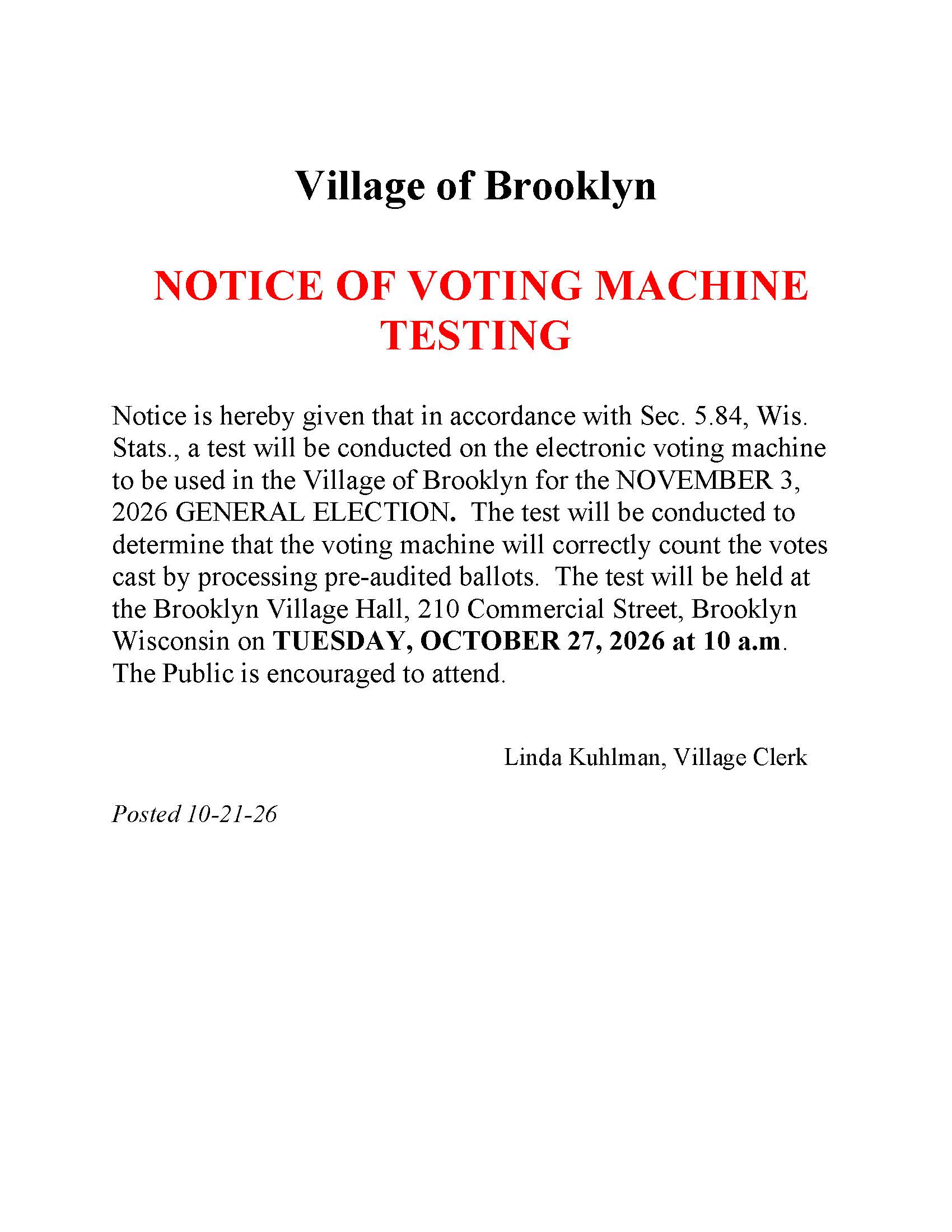
VILLAGE OF BROOKLYN Linda Kuhlman, Clerk 210 Commercial Street Brooklyn, WI 53521 Phone: 608-455-4201/Fax: 608-455-1385 In-Person Absentee Voting Hours:
Oct 20th - Oct 22nd (Tues - Thurs) 7:00 a.m. -4:00 p.m. Oct 23rd (Fri) 7:00 a.m. – noon Oct 26th & 27th Oct 29th & 30th (Mon, Tues, Thurs & Fri) 7:00 a.m.- 4:00 p.m.
|
The first day and last day to vote an absentee ballot in the Clerk’s Office of your municipality is listed above.
NOTICE OF REFERENDUM ELECTION
November 3, 2026
NOTICE IS HEREBY GIVEN, that at an election to be held in the several towns, villages, wards, and election districts of the State of Wisconsin, on Tuesday, November 3, 2026, the following questions will be submitted to a vote of the people pursuant to law:
2025 Senate Joint Resolution 116
To amend section 10(1)(c) of article V; relating to: prohibiting the governor from using the partial veto to create or increase any tax or fee.
Whereas, the 2023 legislature in regular session considered a proposed amendment to the constitution in 2023 Assembly Joint Resolution 112, which became 2023 Enrolled Joint Resolution 16, and agreed to it by a majority of the members elected to each of the two houses, which proposed amendment reads as follows:
Section 1. Section 10 (1) (c) of article V of the constitution is amended to read:
[Article V] Section 10 (1) (c) In approving an appropriation bill in part, the governor may not create a new word by rejecting individual letters in the words of the enrolled bill, and may not create a new sentence by combining parts of 2 or more sentences of the enrolled bill, and may not create or increase or authorize the creation or increase of any tax or fee.
Now, therefore, be it resolved by the senate, the assembly concurring, That the foregoing proposed amendment to the constitution is agreed to by the 2025 legislature; and, be it further
Resolved, That the foregoing proposed amendment to the constitution be submitted to a vote of the people at the election to be held on the first Tuesday of November 2026; and, be it further
Resolved, That the questions concerning ratification of the foregoing proposed amendment to the constitution be stated on the ballot as follows:
QUESTION 1: “Partial veto. Shall section 10 (1) (c) of article V of the constitution be amended to prohibit the governor, in exercising his or her partial veto authority, from creating or increasing or authorizing the creation or increase of any tax or fee?”
2025 Assembly Joint Resolution 10
To amend section 18 of article I of the constitution; relating to: the freedom to gather in places of worship during a state of emergency.
Whereas, the 2023 legislature in regular session considered a proposed amendment to the constitution in 2023 Senate Joint Resolution 54, which became 2023 Enrolled Joint Resolution 11, and agreed to it by a majority of the members elected to each of the two houses, which proposed amendment reads as follows:
Section 1. Section 18 of article I of the constitution is created to read:
[Article I] Section 18. The right of every person to worship Almighty God according to the dictates of conscience shall never be infringed; nor shall any person be compelled to attend, erect or support any place of worship, or to maintain any ministry, without consent; nor shall any control of, or interference with, the rights of conscience be permitted, or any preference be given by law to any religious establishments or modes of worship; nor shall any money be drawn from the treasury for the benefit of religious societies, or religious or theological seminaries; nor shall the state or a political subdivision of the state order the closure of or forbid gatherings in places of worship in response to a state of emergency at the national, state, or local level, including an emergency related to public health.
Now, therefore, be it resolved by the assembly, the senate concurring, That the foregoing proposed amendments to the constitution is agreed to by the 2025 legislature; and, be it further
Resolved, That the foregoing proposed amendments to the constitution be submitted to a vote of the people at the election to be held on the first Tuesday of November 2026; and, be it further
Resolved, That the question concerning ratification of the foregoing proposed amendments to the constitution be stated on the ballot as follows:
QUESTION 2: “Freedom to gather in places of worship during an emergency. Shall section 18 of article I of the constitution, which deals with religious liberty, be amended to prohibit the state or a political subdivision of the state from ordering the closure of, or forbidding gatherings in, places of worship in response to a state of emergency, including a public health emergency?”
2025 Assembly Joint Resolution 102
To create section 27 of article I of the constitution; relating to: prohibiting governmental entity discrimination.
Whereas, the 2023 legislature in regular session considered a proposed amendment to the constitution in 2023 Assembly Joint Resolution 109, which became 2023 Enrolled Joint Resolution 15, and agreed to it by a majority of the members elected to each of the two houses, which proposed amendment reads as follows:
Section 1. Section 27 of article I of the constitution is created to read:
[Article I] Section 27 (1) In this section, “governmental entity” means the state, its political subdivisions including municipalities, the University of Wisconsin System, the Technical College System, any public college or university, any public school district, and any office, department, independent agency, board, commission, authority, institution, association, society, or other body in state or local government created or authorized to be created by the constitution or any law, including the legislature and the courts.
(2) A governmental entity may not discriminate against, or grant preferential treatment to, any individual or group on the basis of race, sex, color, ethnicity, or national origin in public employment, public education, public contracting, or public administration.
(3) This section does not prohibit action that must be taken to establish or maintain eligibility for any federal program, if ineligibility would result in a loss of federal funds to the governmental entity.
(4) Nothing in this section prohibits bona fide qualifications based on sex that are reasonably necessary to the normal operation of public employment, public education, public contracting, or public administration.
(5) If any part or parts of this section are found to be in conflict with the United States Constitution or federal law, the section shall be implemented to the maximum extent that the United States Constitution and federal law permit. Any provision of this section held invalid shall be severable from the remaining portions of this section.
Now, therefore, be it resolved by the assembly, the senate concurring, That the foregoing proposed amendments to the constitution is agreed to by the 2025 legislature; and, be it further
Resolved, That the foregoing proposed amendments to the constitution be submitted to a vote of the people at the election to be held on the first Tuesday of November 2026; and, be it further
Resolved, That the question concerning ratification of the foregoing proposed amendments to the constitution be stated on the ballot as follows:
QUESTION 3: “Governmental entity discrimination prohibited. Shall section 27 of article I of the constitution be created to prohibit governmental entities in the state from discriminating against, or granting preferential treatment to, any individual or group on the basis of race, sex, color, ethnicity, or national origin in public employment, public education, public contracting, or public administration?”
Explanatory Statements as to the Questions
Explanatory statement regarding Question 1:
under current law, the Governor may partially veto language in a spending bill passed by the Legislature. The veto may result in either more or fewer taxes or fees being imposed and may also result in local government entities being authorized to increase or decrease local taxes or fees.
The proposed amendment would add a new clause to Article V, section 10(1)(c) of the Wisconsin Constitution, providing that the Governor’s veto “may not create or increase or authorize the creation or increase of any tax or fee.” This language would not only prevent a veto from increasing any state taxes or fees, but also prevent a veto from allowing local governments, such as school districts, to increase their own taxes or fees.
A “yes” vote on Question 1 would vote to amend Wis. Const. art. V, § 10(1)(c) to prohibit the Governor from partially vetoing a spending bill in a way that would create or increase or authorize the creation or increase of any tax or fee.
A “no” vote on Question 1 would vote not to amend Wis. Const. art. V § 10(1)(c) of the Wisconsin Constitution.
Explanatory statement regarding Question 2:
Under current law, Article I, section 18 of the Wisconsin Constitution, like the First Amendment of the U.S. Constitution, protects religious rights. In a declared state of emergency, officials may limit public gatherings, including religious gatherings, so long as religious and secular gatherings are treated equivalently.
The proposed amendment would add a new clause to the end of Article I, section 18, prohibiting the state and local governments from ordering the closure or forbidding gatherings “in places of worship” when there is a state of emergency. That language would prevent officials from forbidding gatherings in places of worship even when other types of public gatherings have been closed.
A “yes” vote on Question 2 would vote to amend Wis. Const. art. I, § 18. The amendment would prohibit the state and local governments from closing or prohibiting gatherings in places of worship during a state of emergency.
A “no” vote on Question 2 would vote not to amend Wis. Const. art. I, § 18 of the Wisconsin Constitution.
Explanatory statement regarding Question 3:
Under current law, both under Article I, section 1 of the Wisconsin Constitution and the Equal Protection Clause of the Fourteenth Amendment to the U.S. Constitution, states and local governments may not discriminate based on race, ethnicity, color, national origin, or sex except under specific circumstances. For race, color, ethnicity, or national origin, discrimination in favor of or against a group is permissible only if the government has a compelling interest and a narrowly tailored remedy. For sex, discrimination is permissible if it serves an important government interest and is substantially related to that interest. Current law also makes distinctions depending on whether discrimination is overt and intentional, or merely a disparate impact of a neutral policy.
The proposed amendment would create a new provision, Article I, section 27, which would prohibit state and local governmental entities from discriminating or granting preferential treatment based on race, sex, color, ethnicity, or national origin in public employment, public education, public contracting, or public administration.
This language appears to impose stricter standards against discrimination than the standards under current state and federal law.
The amendment contains three exceptions. It does not apply if it would cause the governmental entity (1) to lose eligibility for a federal program or (2) to violate federal law. And the amendment’s prohibition on treating people differently based on sex does not apply to measures that are “reasonably necessary” to the “normal operation” of public employment, education, contracting, or administration.
A “yes” vote on Question 3 would vote to create a new provision of the Wisconsin Constitution—Wis. Const. art. I, § 18, which would prohibit any governmental entity from discriminating or granting preferential treatment based on race, sex, color, ethnicity, or national origin in public employment, public education, public contracting, or public administration.
A “no” vote on Question 3 would vote not to add Wis. Const. art. I § 18 to the
Wisconsin Constitution.
Done in the City of Madison,
on this 1st day of September, 2026.
Scott McDonell, Dane County Clerk
NOTICE OF LOCATION AND HOURS OF POLLING PLACE
VILLAGE OF OREGON < TOWN OF OREGON < TOWN OF RUTLAND < VILLAGE OF BROOKLYN
At the General Election (Gubernatorial) to be held on Tuesday, November 3, 2026 in the Village of Oregon, Village of Brooklyn, Town of Rutland, and Town of Oregon of Dane County, Wisconsin, the following polling place locations will be used for the wards indicated:
Village of Oregon
Wards 1 – 4, Oregon Village Hall, 101 Alpine Parkway, Oregon, WI 53575
Wards 5 – 9, Oregon Public Library, 200 N Alpine Parkway, Oregon, WI 53575
Wards 10 – 16, People’s United Methodist Church, 103 N Alpine Parkway, Oregon, WI 53575
Town of Oregon
Wards 1 – 4, Oregon Town Hall, 1138 Union Road, Oregon, WI 53575
Town of Rutland
Wards 1 – 2, Rutland Town Hall, 785 Center Road, Stoughton, WI 53589
Village of Brooklyn
Wards 1 – 4, Brooklyn Village Hall, 210 Commercial Street, Brooklyn, WI
53521
All polling places will open at 7:00 A.M. and will close at 8:00 P.M. All polling places are accessible to elderly and voters with disabilities*.
Curbside voting is also available for voters who are unable to enter the polling place due to disability. If you have any questions concerning your polling place, contact the municipal clerk.
Village of Oregon: Candie Jones, 101 Alpine Parkway, Oregon, WI 53575
(608) 835-3118, 7:30 a.m. – 4:30 p.m. (Mon-Thurs) 7:30 a.m.- 12 p.m. (Fri).
Town of Oregon: Jennifer Hanson, 1138 Union Road, Oregon, WI 53575
(608) 835-3200, 8:00 a.m. – 4:00 p.m. (Mon-Thurs) Fridays by appointment.
Town of Rutland: Dawn George, 785 Center Road, Stoughton, WI, 53589, (608) 455-3925, Call for appointment.
Village of Brooklyn: Linda Kuhlman, 210 Commercial Street, Brooklyn, WI 53521, (608) 455-4201, 7:00 a.m. – 5:00 p.m. (Mon-Fri)
Notice of Meeting of the Local Board of Canvassers
At the close of voting on Election Day, pursuant to the provisions of Wis. Stat. § 19.84, the Election Inspectors at each polling place will convene as the Local Canvassing Board for the purpose of conducting the local canvass pursuant to Wis. Stat. § 7.51. This meeting will be open to the public pursuant to Wis. Stat. §§ 19.81-89.
Notice of Meeting of the Local and Municipal Board of Canvassers (MBOC)
At the close of voting on Election Day, pursuant to the provisions of Wis. Stat. § 19.84, the Election Inspectors will convene as a joint meeting of the Local Board of Canvassers and the MBOC for the purpose of conducting the local and municipal canvasses pursuant to Wis. Stat. §§ 7.51 and 7.53(1). This meeting will be open to the public pursuant to Wis. Stat. §§ 19.81-89.
Notice of Meeting of MBOC to Process Rehabilitated Provisional Ballots
If provisional ballots have been issued and are subsequently cured by the voter before 4:00 p.m. on the Friday after the election, the MBOC must meet no later than the following Monday at 9:00 a.m. to process the cured provisional ballots. This is a public meeting and requires applicable notice.
Published: 10-29-2026